Showing posts with label Howard Jacobson. Show all posts
Showing posts with label Howard Jacobson. Show all posts
Monday, April 25, 2011
The Mighty Jacobson
Howard Jacobson plays ping-pong and chats about his newly re-issued tour de force.


Friday, January 28, 2011
The Finkler Question by Howard Jacobson
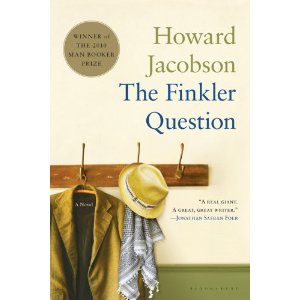 In Howard Jacobson's Man Booker Prize winning novel sad-sack goy Julian Treslove is mistaken for a Jew when he is mugged in the street, or so he thinks. Making matters worse his assailant is a woman. In one fell swoop his sexual and ethnic identity (which is to say his entire identity) have been stolen from him. A personal crisis ensues and Treslove spends most of the rest of the novel ruminating and anguishing about, well, sex and identity. Treslove desperately wants to be Jewish. Why? I'm not quite sure. It may have something to do with the fact that his two closest friends are Jewish, his former teacher Libor Sevcik and Sam Finkler, an old school chum and now a renowned philosopher and media personality. But it's not just their Jewishness Treslove envies, it's their losses. Sevcik and Finkler have both recently become widowers. The combination of love, loss and Judaism are irresistible to Treslove who, aside from being a bore, is an incurable romantic. One more thing Treslove instinctively can't resist about Jews is their penchant for self-hatred. Finkler founds an organization called ASHamed Jews to take a public stand against Israel's actions in Gaza (among a host of other amorphous things Jews have to be ashamed of). Then Treslove becomes fascinated and follows the internet blog of a Jew trying to grow (or more accurately 'stretch') his foreskin back. Self-hatred is something Treslove comes by honestly, and justifiably, having failed repeatedly as a lover and as a father to two sons by different women. He falls in love with the unlikely-named Hephzibah, Libor's great-great niece, a large woman who appears to embody in every way the Jewishness that Treslove craves. He reads a Yiddish dictionary to acquire Jewish idiom in his vocabulary, and aides Hephizbah with the creation of a new museum of Anglo-Jewish life (not a Holocaust museum.) Still (self) acceptance eludes him. This is all intended as ironic, of course, the non-Jew feeling marginalized from history's most marginalized people. I've been a Jacobson fan for a while. I really enjoyed Kalooki Nights, and loved The Mighty Walzer. Those novels were energetic and deftly-written - serious but with a light touch - in a way that The Finkler Question simply isn't. Finkler feels like a performance. The author wanting to say a lot about the state of being Jewish these days. The novel is comprised almost entirely of characters opining, and the humour is heady and forced. But the main problem is that the novel is missing a solid, empathetic core; a central character for whom the reader can genuinely care, as Walzer had Oliver, and Kalooki had Max Glickman. Julian Treslove is a pathetic, self-obsessed drip, a loser who overthinks and spins his wheels in place. There's little that's enjoyable, or particularly funny (or excusable) about watching him sink deeper and deeper into the mire of his own making. As an exposition on the modern Jewish psyche, which it is undoubtedly intended to be, The Finkler Question is tiresome and dreary. As a meditation on friendship it is unrelentingly melancholic. Only a brief glimpse of Jacobson's storytelling brilliance is in evidence when near the very end of the novel he briefly touchingly describes the actual deaths of Libor's and Finkler's wives in successive chapters. The contrast is achingly revealing about their respective marriages, relationships and lives. It's also telling that these sections, the most authentically and beautifully wrtten in the novel, were not about Treslove. Still, I'm thrilled the novel won the Man Booker. Hopefully, it will bring more attention to Jacobson's superior earlier novels. I have no doubt that the award jury intended it that way.
Sunday, October 3, 2010
The Mighty Walzer by Howard Jacobson
 Howard Jacobson said that his 2006 novel Kalooki Nights was his most Jewish novel. It was possibly the most Jewish novel ever written, the author claimed. Well I'm here to tell you that he was wrong. Possibly the most Jewish novel ever written was Jacobson's 1999 autobiographical bildungsroman The Mighty Walzer. A book he calls his "history of embarrassments," it's also possibly one of the funniest, most insightful and touching Jewish novels ever written. Jacobson showed with Kalooki Nights that he, and Jews, have a thing for games (kalooki is a card game akin to gin rummy). As a tribe, we have shown a talent for other games too, like chess for instance - according to one source, almost half of the all-time greatest chess players have been Jewish or of Jewish decent (think Garry Kasparov, Bobby Fisher). In the early decades of the 20th century, it could be argued that ping-pong was the Jewish game. If you don't believe me look up the name Viktor Barna. Given the cultural and religious emphasis we place on education, Jews excelling at thinking games is not hard to understand. But a game in which players use rubber-coated paddles to slap a small white ball back and forth across a table? Although I can't explain it myself, I can remember the ping-pong table we had in our basement. And we were by no means the only family in our predominantly Jewish neighbourhood to have one. We had a large basement that was divided into two rooms. One side was for ping-pong and hockey slapshots. The other side held a full-sized snooker table. It was an unspoken understanding among my friends and me that the billiard side was reserved for the grown-ups. We spent hours on the other side playing impromptu ping-pong tournaments. And once, I recall that I spent an entire afternoon at my best friend's house around the corner batting the ball back and forth on his ping-pong table in an attempt to establish a new world record for the longest unbroken ralleye (a world record had to exist.) Ping-pong was still a fixture of a 1970s boyhood, and it's a measure of the game's importance, not merely recreationally but also culturally, that the disappearance of those tables from home basements coincides with the advent of revolutionary technology; the pock-pock of wooden paddle and plastic ball replaced by the bleep-bleep of dials and luminescent dashes on a black screen, and the era of home computing was upon us. I may have been born a generation after Howard Jacobson, but I 'get' his visceral connection to the game. In his brilliantly layered exposition of its various facets, ping-pong, which he says "suffered from too modest a conception of itself," becomes the perfect metaphor for a withdrawn, sexually repressed, working-class Jewish kid's struggle for both social and self-acceptance in 1950s Manchester, England. Oliver Walzer discovers early on that he doesn't possess many talents, but one that he does have involves batting a ball against a wall using a copy of Doctor Jekyll and Mr. Hyde. His other talent, if one can call it a talent, is to make paper dolls out of pictures of his female family members and jack-off to them in the bathroom. As disturbing as this sounds, Jacobson succeeds in making it seem borderline charming. And that's his game as an author, his (Jewish) talent, the ability to perform unlikely literary feats with grace on a tightrope strung fifty feet in the air between two poles; anxiety and hilarity. Oliver's first non self-inflicted sexual encounter is with the always-eager-to-please Sabine Weinberger, and even that plays out like a ping-pong match, with Oliver lying on one side of her and his buddy Sheeny Waxman on the other. But it's ping-pong playing Lorna Peachley and her 'moving parts' that Oliver genuinely fancies. His love is true, so much so that he must continually lose to her in matches. Outside the game, Oliver helps his father make a living selling 'swag' to 'punters', but bemoans that everything is becoming 'tsatskes' and worse, 'machareikes', "that moral infection of triviality to which both sides of my family had always been susceptible." (If you're unfamiliar with Yiddish terms a copy Leo Rosten's The Joys of Yiddish will come in handy). At one point Oliver complains that in spite of winning trophies and being named to represent Britain at international table tennis tournaments, his anti-Semitic headmaster neglects to announce his accomplishments publicly at school assemblies. Echoing this situation is Jacobson, who, in spite of his literary accomplishments, has failed to gain the international recognition he so richly deserves as a major novelist. Hopefully this will all change with a Booker Prize this year. His latest novel The Finkler Question is a finalist. I still can not fathom how The Mighty Walzer was ever missed. It is quite simply a coming-of-age masterpiece.
Subscribe to:
Posts (Atom)