All too often, reading contemporary poetry, what I feel is, So many dishonest lines! Lines that sound beautiful but that aren’t meant. If you aren’t really paying attention, you can be seduced by them. But if you’re listening closely, they don’t ring true. They have the sound of trying too hard, or of trying to put something over. They sound as though they are listening to themselves, admiringly, rather than speaking from a real place inside the poet. The words may be gorgeous, they may be clever, they may have dazzle or flash, but they aren’t speaking in a real voice.
Robyn Sarah again on telling the truth in poetry. What she says about poetry is equally true in fiction. I wonder if she would agree with my contention that what she calls writers listening to themselves, admiringly, rather than speaking from a real place may be the result of the 'academization' of writing ie. more writing coming out of university creative writing programs. And bonus; she quotes Joseph Epstein, one of my favourite writers.
Friday, February 25, 2011


Monday, February 21, 2011
Walking the public/private fine line
For writers who use language as an artistic medium, a tension goes with this dichotomy: the process of creation is intensely private, yet the creation will not be complete, will not have fulfilled its purpose, without an audience. Thinking too much about “audience” during the creative process can inhibit the process and distort the creation, but thinking too little about it can do the same. Soon enough one needs to ask, “Who am I writing this for?”, because it is the sense of audience that gives writing its voice. Voice, style, tone, are how a piece of writing treats its reader.
Robyn Sarah on the writer's challenge to find the perfect public/private balance.
Robyn Sarah on the writer's challenge to find the perfect public/private balance.
Tuesday, February 15, 2011

Monday, February 14, 2011
Jewgrass and Canlit
 Not your Bubbie's klezmer says Bev Akerman over at Rover riffing on the recent Shabbat Shira sold-out shindig at our shul. But anyone who knows a little about klezmer knows that it's taken many forms over the last few decades, particularly in the US, ranging from groups like Boston's The Klezmer Conservatory to New York's Klezmatics, not to mention John Zorn's Klezmer-inspired Jazz-infused musical experiments. Being an island of Jews in a lake of Quebecois in an sea of Anglos has made the Montreal Jewish community uniquely conservative in character and consequently late to catch a ride on the upcoming cultural waves. But I'm proud to say that our little shtibel (the only Reconstructionist synagogue in a city of eighty or so Orthodox minyans) is trying to do its part to open a few doors and windows a crack, let some cultural fresh air in to the stagnant atmosphere. A culture is vibrant when artists (be they writers, painters, sculptors, actors, musicians, poets, whomever) feel they have the license to combine their own personal traditions with a myriad of other influences. Today is the 102nd anniversary of the birth of A.M. Klein, a Montreal Jewish writer and one of Canada's greatest poets. A writer who left his mark by combining Hebrew liturgy, Yiddish idiom, a mastery of English literary forms, a fluency in French and profound sensibility for Quebecois culture. So you ask, Jewish bluegrass from Montreal? I say you're darn tootin! And mazel tov to Bev on her new collection of short fiction. Strength to strength!
Friday, February 11, 2011
Monday, February 7, 2011
A Writer's Life
I thought back to my days in Miss Jeffries’ Grade 10 creative writing class, where my thoughts went along the lines of: How can I entertain myself? (and as a secondary notion, How can I totally gross out anyone who reads this, particularly Courtney Smith, with her neon green scrunchie, whom I sort of like? — what can I say: I was 15, and not the suave Lothario I am today). I had to rekindle the joy I’d felt when the page just opened up, I fell in, and there were no limitations or worries about target demos, what editors will think, the booksellers, the whole apparatus I’d no knowledge of when I’d first said to myself: Hey, it would be pretty cool to write all day long.
Craig Davidson tells it like it is for most writers.
Craig Davidson tells it like it is for most writers.
Friday, January 28, 2011
The Finkler Question by Howard Jacobson
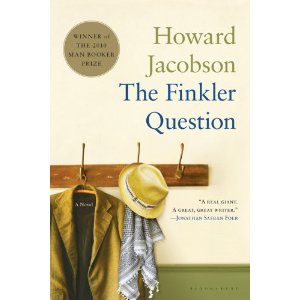 In Howard Jacobson's Man Booker Prize winning novel sad-sack goy Julian Treslove is mistaken for a Jew when he is mugged in the street, or so he thinks. Making matters worse his assailant is a woman. In one fell swoop his sexual and ethnic identity (which is to say his entire identity) have been stolen from him. A personal crisis ensues and Treslove spends most of the rest of the novel ruminating and anguishing about, well, sex and identity. Treslove desperately wants to be Jewish. Why? I'm not quite sure. It may have something to do with the fact that his two closest friends are Jewish, his former teacher Libor Sevcik and Sam Finkler, an old school chum and now a renowned philosopher and media personality. But it's not just their Jewishness Treslove envies, it's their losses. Sevcik and Finkler have both recently become widowers. The combination of love, loss and Judaism are irresistible to Treslove who, aside from being a bore, is an incurable romantic. One more thing Treslove instinctively can't resist about Jews is their penchant for self-hatred. Finkler founds an organization called ASHamed Jews to take a public stand against Israel's actions in Gaza (among a host of other amorphous things Jews have to be ashamed of). Then Treslove becomes fascinated and follows the internet blog of a Jew trying to grow (or more accurately 'stretch') his foreskin back. Self-hatred is something Treslove comes by honestly, and justifiably, having failed repeatedly as a lover and as a father to two sons by different women. He falls in love with the unlikely-named Hephzibah, Libor's great-great niece, a large woman who appears to embody in every way the Jewishness that Treslove craves. He reads a Yiddish dictionary to acquire Jewish idiom in his vocabulary, and aides Hephizbah with the creation of a new museum of Anglo-Jewish life (not a Holocaust museum.) Still (self) acceptance eludes him. This is all intended as ironic, of course, the non-Jew feeling marginalized from history's most marginalized people. I've been a Jacobson fan for a while. I really enjoyed Kalooki Nights, and loved The Mighty Walzer. Those novels were energetic and deftly-written - serious but with a light touch - in a way that The Finkler Question simply isn't. Finkler feels like a performance. The author wanting to say a lot about the state of being Jewish these days. The novel is comprised almost entirely of characters opining, and the humour is heady and forced. But the main problem is that the novel is missing a solid, empathetic core; a central character for whom the reader can genuinely care, as Walzer had Oliver, and Kalooki had Max Glickman. Julian Treslove is a pathetic, self-obsessed drip, a loser who overthinks and spins his wheels in place. There's little that's enjoyable, or particularly funny (or excusable) about watching him sink deeper and deeper into the mire of his own making. As an exposition on the modern Jewish psyche, which it is undoubtedly intended to be, The Finkler Question is tiresome and dreary. As a meditation on friendship it is unrelentingly melancholic. Only a brief glimpse of Jacobson's storytelling brilliance is in evidence when near the very end of the novel he briefly touchingly describes the actual deaths of Libor's and Finkler's wives in successive chapters. The contrast is achingly revealing about their respective marriages, relationships and lives. It's also telling that these sections, the most authentically and beautifully wrtten in the novel, were not about Treslove. Still, I'm thrilled the novel won the Man Booker. Hopefully, it will bring more attention to Jacobson's superior earlier novels. I have no doubt that the award jury intended it that way.
Subscribe to:
Posts (Atom)